
Recyclability of Packaging: Article 6 of the PPWR
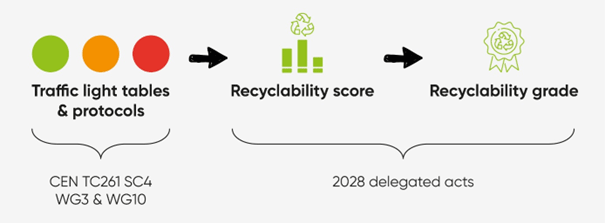
Based on existing European CEN standards, packaging is initially classified using a color code:
- Green: well recyclable
- Yellow: limited recyclability
- Red: non-recyclable
This traffic-light rating will later be:
- translated into concrete numerical values (mass percentages), and
- assigned to a PPWR recyclability grade (A, B or C).
This will precisely define how well a packaging item can actually be recycled.
Until the delegated acts are published in early 2028, the CEN standards for design for recycling can therefore serve as a solid basis.
A core principle of the PPWR is Design for Recycling. Packaging must be designed so that:
- all components can be separated into different material streams,
- collection, sorting, and recycling processes can be carried out efficiently,
- technical and economic feasibility as well as environmental impacts are considered (e.g., energy demand, greenhouse gas emissions).
The Design for Recycling Guidelines will set binding criteria for each packaging category. They will address in particular:
- material selection and composition,
- assessment of the entire packaging: integrated components must be included unless they separate due to mechanical stress during transport or sorting; such components are then assessed separately,
- consideration of existing infrastructure: only processes proven in practice will be included in the assessment.
From 2035 onward, it is no longer sufficient for packaging to be theoretically recyclable: it must also be actually recycled at scale. This means it must be possible to separately collect, sort, and recycle it.
For each packaging type listed in PPWR Annex II, Table 2, an EU-wide minimum recycling rate of 55% applies, based on the actual packaging waste generated.
How exactly these rates are to be measured will be determined by the EU by 2030.
The PPWR permits exemptions for certain materials (e.g., wood or ceramics), specific applications such as pharmaceuticals or hazardous goods, innovative packaging with environmental benefits, and selected compostable packaging. These exemptions will be regularly reviewed.
To create incentives for better recyclability, compliance fees (EPR fees) for packaging will be aligned with and tiered according to the recyclability performance grades:
- A (>95%): lowest fee
- B (>80%): medium fee
- C (>70%): highest fee
The framework and criteria will also be defined in a delegated act by 1 January 2028.
Greiner Packaging pursues a consistent sustainability strategy, integrating design for recycling into product development already today. The goal is to design packaging that is not only theoretically recyclable but can also be effectively processed in real-world collection, sorting, and recycling systems, fully in accordance with the direction set by the PPWR.


