4 Pet-Food Trends You Should Be Aware Of in 2026
Pet food packaging is evolving. And with the U.S. pet food market being the largest in the world, Pet food is no longer just about nutrition. Today’s pet parents expect convenience, sustainability and extended shelf life. In fact, they demand the same quality from pet food packaging as they do from the packaging of their own food. That’s why brands are raising their standards.
In this blogpost, we highlight four key trends shaping the pet food and pet care industry and how Greiner Packaging’s expertise helps meet both consumer expectations and brand ambitions.
Jump directly to:
Trend 1: Product Shelf Life
The demand for longer product shelf lives without preservatives, while providing good product protection, is growing. Especially wet pet food packaging faces particularly high demands: it must not only protect the product but also keep it shelf-stable for long periods, often without refrigeration. This is critical for both freshness and, above all, food safety, since the packaging’s role is to prevent the growth of harmful germs.
Preserving freshness, retaining taste and aroma, and minimizing food waste are top priorities. The solution: retort barrier packaging — a specially engineered option designed precisely for these challenges.
Greiner Packaging’s retort barrier solutions for wet pet food offers:
- Oxygen protection to slow fat oxidation and prevent flavor loss
- Light protection to safeguard nutrients
- Moisture retention to ensure consistent texture
At the heart of this barrier packaging solution is a seven-layer foil structure, specifically designed for the retort process. The outer layer, typically made of polypropylene (PP), provides flexibility and durability. The central barrier layer — ethylene-vinyl alcohol (EVOH) — delivers exceptional protection against oxygen and moisture, helping prevent oxidation and nutrient loss. It also plays a key role in maintaining food safety by inhibiting microbial growth. Because EVOH content must be approved under FDA food-contact regulations, formulations must comply with these requirements. Also, recycling compatibility depends heavily on the EVOH percentage, with less than 5% EVOH preferred to meet APR guidelines. Additional layers ensure strong adhesion and structural stability, keeping the entire packaging system reliably bonded.
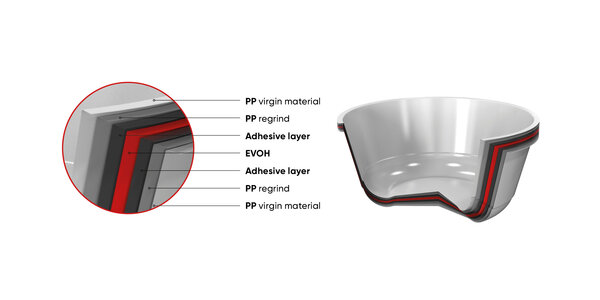
![]()
The result?
- Superior protection against air and light
- Extended shelf life without compromising product quality
- Optimal performance for sensitive, high-value products
Trend 2: Sustainability
Environmental responsibility is no longer optional. Pet parents expect food to not only remain fresh and safe, but also to be packaged in an environmentally friendly manner, whether it’s wet or dry pet food. As Packaging Digest reports, leading companies such as Nestlé Purina PetCare Co. are rethinking their packaging portfolios to reduce plastic use, improve recyclability, and align with circular economy goals.¹ Large retailers such as Walmart or Target are also influencing sustainable pet food decisions, alongside expanding state-level extended producer responsibility (EPR) legislations.
Sustainability in Petfood includes:
To support a circular economy, packaging must be designed for easy recycling and efficient material recovery. Mono-material solutions, such as cups and lids made from the same material, help ensure proper sorting into the correct recycling stream. A great example is Greiner Packaging’s solution for dry pet food: their cup and Sealing Lid combination eliminates the need for an additional sealing foil, resulting in a fully mono-material pack that significantly improves recyclability. According to Packaging Dive, many well-known brands have also transitioned to fully recyclable packaging. For instance, French pet food maker Saga Nutrition replaced its non-recyclable dry-food packaging with a recyclable mono-material bag. Similarly, Nestlé Purina PetCare launched recyclable cat treat canisters in the U.S. last year.2
Looking ahead, Greiner Packaging is also working on a Sealing Lid solution for wet pet food, which can incorporate EVOH to meet the high demands of food safety and shelf life, while still being able to be recycled in the PP stream, supporting recyclability and compliance with future regulations.
Lighter packaging reduces material use and lowers transport emissions, helping brands cut CO₂ and meet sustainability targets. Compared to aluminium cups, metall cans, or multiple component packaging (e.g. cup/lid/foil), plastic materials can significantly reduce emissions specifically in production and logistics.
Incorporating post-consumer recycled materials, such as r-PET, into dry pet food packaging helps conserve energy and resources by giving materials a second life. These recycled materials can be integrated into packaging structures (e.g., ABA formats) to boost sustainability without compromising performance. For pet food packaging made from PP, solutions incorporating mechanically recycled PP (r-PP) are currently under development by Greiner Packaging and will soon be available. Following the U.S. Food and Drug Administration’s Letter of No Objection (LNO), mechanically recycled PP is approved for selected food-contact applications in the U.S.
Greiner Packaging’s thermoformed flapper lid, developed by their in-house design and prototyping agency called “Despro”, uses approximately 35% less plastic than traditional injection-molded lids. Made from a single part and one material, the lid remains attached to the packaging and opens only at the flap, making it a mono-material solution.
Trend 3: Safety & Convenience
Today’s pet parents expect packaging that is both safe for their pets and easy to use — whether at home or on the go. One of the biggest drivers here is the trend of “humanization”: pet food should be just as convenient, safe, and intuitive to use as human food.
- On-the-go packaging concepts have therefore become essential. Cups designed for portability make it easy for pet parents to serve dry food anytime, anywhere — whether at the park, on a trip, or during daily routines. Compared to flexible formats, rigid plastic packaging offers better handling — it can be opened and re-closed easily without spilling contents or losing product. This makes it a practical and reliable choice, especially for on-the-go feeding.
- At home, packaging should also simplify feeding. Eliminating the need for extra utensils ensures food can be served cleanly and effortlessly. Easy emptying is key: the entire portion should be removable without needing a spoon or fork, especially wet pet food.
Innovation Spotlight: Greiner Packaging’s integrated handle and corner-opening design make the dosing and pouring of dry pet food intuitive. How? A special injection-molded sealing lid stays attached to the pack and opens only partially, ensuring easy access and secure reclosure — while eliminating the need for an additional sealing film. This is particularly convenient for dry pet food treats or larger dry pet food packs. For wet pet food, Despro developed the innovative “slip-out pack”*, which eliminates the need for utensils altogether. Thanks to its special inner coating, pet parents can simply press the top of the cup and the entire portion slides out — cleanly, easily, and without residue.
*This solution was created by Greiner Packaging’s in-house Design & Prototyping Agency and is a conceptual design, not a ready-to-sell solution.
Trend 4: Point-of-Sale Variety
Beyond convenience, packaging must also stand out on the shelf. Unique shapes, bold geometries, and innovative decoration technologies help brands capture attention and differentiate from competitors. Eye-catching formats combine visual impact with serving convenience, ensuring that style never comes at the expense of usability. As highlighted by PackagingInsights, brands are responding to the humanization trend with “customized, colorful, and fancy packages” that feature detailed nutritional information and premium aesthetics.3
Decoration technologies also play a key role in brand storytelling. For example, in-mold labelling offers a wide range of decorative effects — including matte, textured, glossy, metallic, or soft-touch finishes. For dry pet food, Greiner Packaging’s K3® cardboard-plastic cup is another great option. It provides premium branding opportunities on two surfaces — the front and the inside of the cardboard wrap — while also adding stability to the plastic cup. This allows for thinner walls and reduced plastic use.
1 & 2: Packaging Digest. (2025, July 10). Sustainability leads pet food brands in new packaging directions.
https://www.packagingdigest.com/sustainability/sustainability-leads-pet-food-brands-in-new-packaging-directions
3 PackagingInsights. (2025, April 30). Pet food packaging: Paperization and pouches proliferate amid humanization trend. https://www.packaginginsights.com/news/pet-food-packaging-trends-2025.html
Conclusion
Pet food packaging is evolving rapidly — and Greiner Packaging is leading the way with innovative, market-ready design solutions. By combining sustainability, safety, shelf life, and convenience, we create ideal conditions for your pet food to succeed.
Get in touch with us today to explore a tailor-made packaging solution that meets your brand’s needs and your customers’ expectations.
Contact Us Today!
Related articles